Yes or No Wheel: Make Quick Decisions Instantly
The modern coin flip alternative that turns indecision into excitement

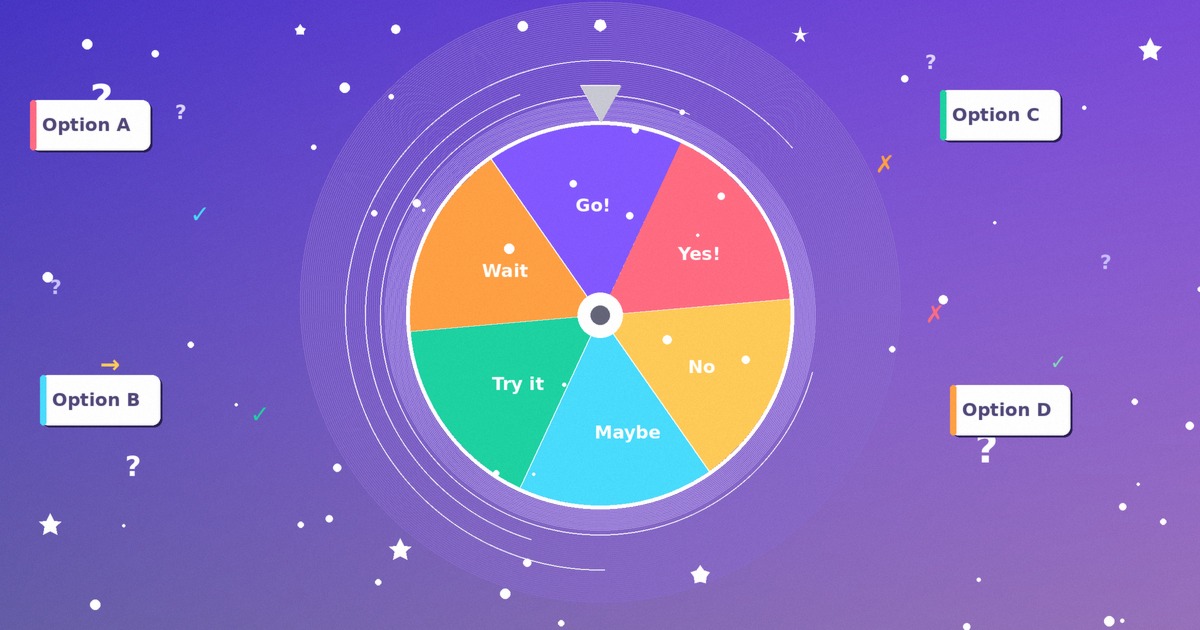
Should I go to the gym? Text them first? Buy the thing sitting in my cart? Say yes to Saturday? Most days are stacked with these little forks in the road. And here's the catch with a lot of them: there's no right answer. Both options are fine. Yet we stall, we re-weigh, we open three tabs and close them again. Spread across a week, that low-grade dithering quietly eats real energy. That's the gap a <a href="/yes-no-wheel/">Yes/No wheel</a> fills. Think of it as a coin flip with better stagecraft — the spin builds a beat of suspense, and the landing feels decisive in a way a coin clinking on the floor never quite does. This guide digs into why binary choices stall us, when a wheel genuinely helps (and when it absolutely shouldn't), and a trick for turning a random result into real self-knowledge. Because now and then, the smartest move is to stop deciding.
When to Use a Yes/No Wheel
✅ Good candidates:
• Both outcomes carry roughly equal weight
• You've been ping-ponging for days with nothing to show for it
• The choice is low-stakes or easy to undo
• You honestly have no preference
• Two people are deadlocked and need a neutral tiebreaker
• You want to shake a little spontaneity into a routine
❌ Leave these to your own head:
• Big, life-shaping calls — career, relationships, health
• Anything irreversible with real consequences
• Moments when your gut is already shouting
• Ethical or moral questions
• Choices that land on other people who didn't agree to a spin
The filter is one question: would I be fine with either result? If yes, spin away. If one outcome would genuinely sink your stomach — well, that flinch is your answer, and you didn't need the wheel to find it.
The Psychology Behind Binary Decision Paralysis
Fear of regret. We pre-play the regret of whichever door we don't open. A wheel quietly dissolves that — you didn't pick, so there's nothing to second-guess.
Maximizer vs. satisficer. Maximizers hunt for the best possible option; satisficers settle happily for good enough. If you're a maximizer, binary calls are torture, because you keep chasing a certainty that was never on offer.
Analysis paralysis. Think long enough and you'll find solid reasons for both sides. Past a point, more thinking doesn't sharpen the choice — it just postpones it.
Commitment anxiety. Saying yes to one path means closing the others. The wheel commits on your behalf and steps right over that knot.
None of this means you're indecisive. It means the human brain is wired to treat a 50/50 as if a hidden 'correct' answer is waiting to be uncovered. Usually it isn't.
How to Use the Yes/No Wheel Effectively
- Phrase the question as a clean yes/no. Fuzzy questions hand back fuzzy guidance.
- Decide, before you spin, that you'll honor the result. This part is the whole game.
- Open the Yes/No wheel and clear your head — no trying to predict or nudge it.
- Spin, and watch it commit.
- Catch your very first reaction to where it lands: relief, or a small sinking feeling?
- Relief means the wheel got it right. A sink means you wanted the other answer all along — so take that one.
The Gut-Check Technique
The method:
1. Spin for your question.
2. The instant it lands, read your own reaction before your brain writes a story about it.
3. Disappointed? You wanted the opposite.
4. Relieved? The wheel matched what you already wanted.
5. Nothing at all? It genuinely doesn't matter — go with the result and move on.
Why it works: your subconscious tends to know the answer well before you'll admit it out loud. A concrete result yanks an honest, unrehearsed feeling to the surface.
A few real shapes this takes:
• Wheel says NO to the party and your chest drops — you wanted to go.
• Wheel says YES to the purchase and you exhale — you were waiting for permission.
• Wheel says NO to texting first and you feel… nothing. Truly a toss-up; proceed.
The wheel isn't an oracle. It's a mirror with good timing.
Yes/No Wheel vs. Coin Flip vs. Decision Apps
The coin flip. Free, instant, two outcomes. But a coin gives you no room to weight the odds, nothing to customize, and a flick of the thumb is easy to wave off as 'best two out of three.' There's also no record of what you flipped.
Decision apps. Many are perfectly good — and many also want an install, an account, a splash of ads, or an upgrade prompt before they'll do the one thing you came for.
A browser-based wheel. It keeps the coin's speed but adds the parts a coin can't: you can weight 'Yes' to 60% when you're leaning but not sure, swap in a third option, and the slow wind-down makes the result land like a decision rather than a flick. Nothing to install, nothing to sign up for.
If you only ever face clean 50/50s with zero preference, a coin is fine. The moment you want to tilt the odds, add a 'maybe,' or feel the result more, the wheel pulls ahead. And when the question stops being binary — 'where do we eat,' 'who goes first' — that's the cue to switch tools entirely, to the what-to-eat wheel or a random name picker.
Beyond Basic Yes/No: Smarter Configurations
Weighted yes/no. Hand 'Yes' a 60% share when you're leaning that way but still want randomness to have a vote. It's the honest middle between a free choice and a coin.
Add a third slice. Drop in 'Maybe / later' for calls that don't need an answer today. Sometimes the true answer is 'not yet.'
Conditional options. 'Yes, but…' and 'No, unless…' force you to name the condition that would flip your answer — which sometimes reveals the answer on its own.
Best of three. For a slightly weightier call, require three spins to agree. Raising the bar a notch keeps the stakes and the method in proportion.
Want the mechanics behind all of this? The complete spin wheel guide walks through weights, presets, and saving wheels you reuse.
What People Actually Spin For
Daily life: Work out today? Order takeout? One more episode? Hit snooze? Take the afternoon off?
Social: Go to the thing? Text first? Accept the invite? Post it or sit on it? Apologize first?
Money: Buy it now, or wait for the sale? Splurge on the nicer one? Return it?
Work: Speak up in the meeting? Apply for the role? Ask for the raise?
Every one of these is low-stakes and reversible — exactly the territory the wheel is built for. Notice what's missing: nobody's spinning 'should I quit my job' or 'should we break up.' Those earn your full attention, not a slice of green and a slice of red.
A Quick Word on Letting Chance Decide
Spend energy where it counts. The Stoics pushed hard on a simple idea — pour yourself into what you control, and make peace with the rest. For two genuinely equal options, the 'choice' was never really in your hands; the randomness just admits it.
Indecision has a price tag. Time spent deliberating is time not spent doing. For small calls, a decent choice made now beats a perfect one made next week, every time.
Decision fatigue is real. Your daily supply of good judgment is finite. Automating the trivial stuff with a wheel isn't laziness — it's keeping powder dry for the decisions that deserve it.
So no, the wheel won't run your life. But for the hundred tiny forks that don't deserve a committee meeting in your skull? Let it spin.
Conclusion
A Yes/No wheel isn't about dodging responsibility. It's about noticing when a decision is pulling far more mental energy than it's worth — and cutting the cord. When both doors lead somewhere fine, the pick stops mattering. Moving does. So use it two ways at once: as a tiebreaker, and as a mirror. The flicker of feeling when it lands tends to tell you what you actually wanted, and that's worth more than the spin itself. The Yes/No wheel on wheel.expert is free, instant, and — let's be honest — far more satisfying than a coin skittering under the couch. Stop circling the question. Give it a spin, and see what your gut does next.
Done overthinking it? The Yes/No wheel is free, no signup, ready when you are.
Spin Yes or NoFrequently Asked Questions
Is the Yes/No wheel truly random?
Yes. wheel.expert draws every spin from the Web Crypto API (crypto.getRandomValues), the same randomness browsers use for security. By default it's a clean 50/50, and no spin is influenced by the last one.
Can I change the odds from 50/50?
You can. Use the weight setting to tilt it — give 'Yes' a weight of 2 and it lands yes about two-thirds of the time. It's handy when you're leaning one way but still want chance to weigh in.
Should I use this for important decisions?
No. Keep it to choices where both outcomes are roughly equal and low-stakes. Big, hard-to-reverse decisions deserve real thought, not a slice of green and a slice of red.
What if the result disappoints me?
That disappointment is the most useful thing the wheel gives you — it's your real preference surfacing. Honor it and choose the option you clearly wanted.
How is this better than flipping a coin?
The spin builds a moment of anticipation and the result feels more committed, so it's harder to shrug off as 'best of three.' You also get things a coin can't do — weighted odds, a third option, and a history of past spins.
Can I add a 'maybe' as a third option?
Yes. Add 'Maybe' or 'Later' as a third slice for questions that don't need an answer right now. Not every fork needs to be forced into two paths.
What if my question isn't really yes or no?
Then reach for a different wheel. For 'where should we eat' try the food wheel, and for 'who goes first' a name picker is the better fit — the yes/no wheel is purpose-built for binary calls only.